Friday, 29 March 2013

Easter Ingredients

As usual, I met Margarita in the market where we shop every Friday for the Casa J's weekly groceries.  Today was the busiest day I have ever seen that market!  It wasn't only for the last minute fresh items that the people were there to purchase, but also for all the extra vendors trying to sell their ingredients for the big Easter dinner.

Last year I blogged about the 12 Plates of Easter, an old Cusco tradition of twelve plates that are symbolic somehow of the twelve apostles.  Today, every family celebrates uniquely, with their favorites, and not many with twelve different plates; however, the traditional family dinner is served up every Good Friday.

Today I got a first-hand look at the ingredients that go into many of the favored dishes.


A very busy market
The meat aisle was practically empty today.  Eating meat is eliminated on Good Friday (out of respect to Jesus' death). 


Fish, however, is a common replacement, and the line-ups were long, wrapping around the corners.


In fact, many of the sought-after ingredients come from the sea.   Imported many miles from the coast, and with advantage to the nature of this holiday, some of these ingredients have high prices ranging from 75 - 150 Peruvian Soles per kilo.

L to R: a dried sea-weed, Chancaca and dried fish eggs.

Chancaca often comes in brown balls, which I finally learned today is actually a source of natural, unrefined sugar that comes from sugar cane. It may be processed and sold in different forms including different base ingredients like honey and orange-peel for flavoring.
It is a common ingredient in some Peruvian desserts like Rice Pudding, or the purple corn sauce called Mazamorra.

On the left are balls of Chancaca
Dried sea-weed (probably some kind of kelp) and fish eggs are commonly used in different soups, and surprisingly aren't that fishy in flavor. These red rish eggs are rich in vitamins A, D, zinc and DHA. 
The ancient Peruvian trekked many miles, many days to carry these healthful items from the sea to their Andean villages high in the altitudes.

A 100 gram bag of shrimp is selling for around S/. 7.50.  That's a little less than $3 CAD, which seems okay to me, but here is considered high (because of the holiday).
 
Preserve-dried shrimp.  Right upper corner: a bag of cinnamon bark.
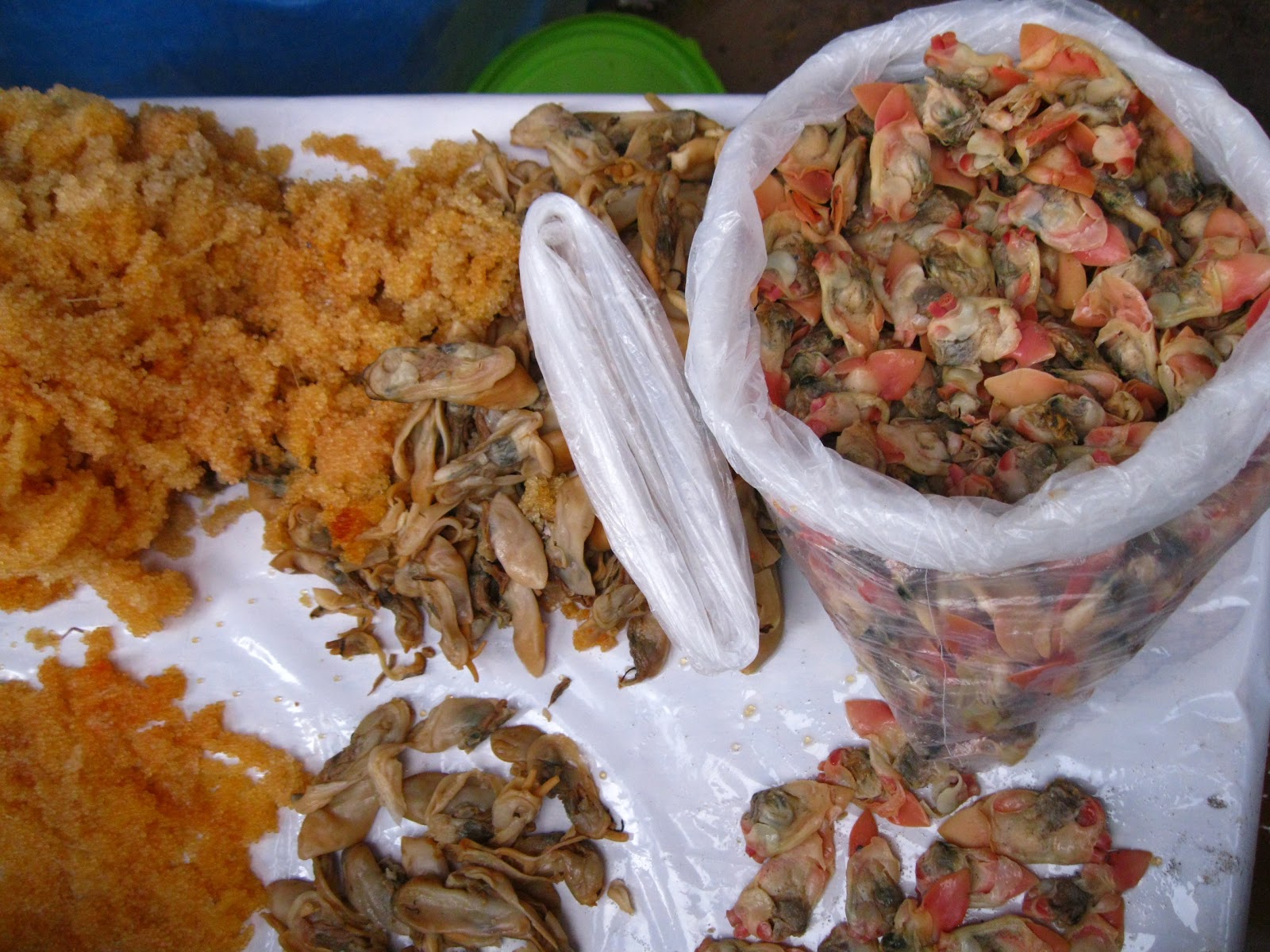
Clam meat is also popular on people's mental Easter shopping lists as they shuffle along the busy aisles, looking for the perfect ingredients.  The clam meat below had been previously soaked and is ready to use; however, here it usually comes dry and should be soaked overnight for faster cooking.
L- R: fish eggs and the meat from small clams

More shrimp and clam meat
Many families prepare at least a couple of desserts for their menu, and boiled peaches are a popular one.  The peaches are skinned and boiled in sugar water with cinnamon and cloves.  Easy and delicious (no recipe required)!


Different cookies and breads are also prepared special for this occasion.  You know those meringue foamy-looking cookies?  Those ones are popular here for Easter and at Christmas too, and prepared in a range of different pastel colors (sorry, no pics).

 
These sweet-flat breads remind me of pop-tarts without the filling.  They are popular for Good Friday breakfast, but you can find them in some Panederias (Bread shops) all year round.    
 

Panacillos- sweet baked flat breads
 
Walter remembers when he was young, that they used to have special breads, tamales and hot chocolate for Good Friday breakfast.


These Catholic cross decorations are made with different live ingredients, bought to be hung above the principal family house door, symbolizing protection over the home.


Some other vital Easter ingredients:
 
-profound love, obedience, humility, service, sacrifice
miracles, resurrection, life, joy
saviour, soul-peace, eternity


What ingredients will make up your Easter this weekend?


Sunday, 17 March 2013

Cultural Differences: Marriage & Children


There’s a lot to navigating a new culture.  It takes time and sensitivity to learn what areas are culturally offensive to people here.  It also takes time and grace to face the areas that I may be offended by.
Since we got married, it seems that it’s every Peruvian’s business to ask when we plan to have children?  Are we pregnant yet?  When will we have a baby?  Do we want a boy or a girl first?
I suppose that this is a common question for newlyweds in Canada, and perhaps worldwide, although in my culture I tend to think that it’s a query more common between closer friends and family. 


The issue I have is that even when I give an answer (that in my eyes should warrant an end to the question, at least for some time) the question is asked again on many more occasions.  I have had one lady that I work with ask me nearly every months when we will have a baby.  My answer the first time should have given us at least a year without harassment.  I’ve had another co-worker from the Casa tell me the same story three times regarding a couple she knows who were in their 30’s when they got married and started a family immediately because they “weren’t getting any younger” and how they now have 5 children (or is it 6?).  For crying out loud, an 11 year old girl that I see from time to time on my way to the orphanage asked me if I was pregnant yet.  And- when I have a baby will I want a girl first or a boy?  But- that doesn’t matter, right, only that it’s healthy.  (Her words, not mine!).  When I was 11 I was into books or building forts, and I really doubt that it ever crossed my mind about the pregnancy status of older women!  In fact, this girl was not the first young person to ask me this... a few days after our wedding, a girl of about 16 asked me if I was pregnant.  Immediately I looked at my stomach- I didn’t think I looked “fat”!  I was a bit surprised and taken a-back.   Where did that question come from?

A couple of weeks ago, in a common conversation in taxi, after answering the driver that I am married, and that no, we don’t have children yet, he asked if my husband is working.  “Pero, funciona tu esposo?”  He didn’t mean in the employment sense.  Just recently a nurse asked how many children we have.  I said that we’ve only been married 9 months.  Her first question after was, “but your husband works?”  I am still not sure if she was referring to the same as that of the Taxi driver or not.
Walter has told me that it is natural here for newlyweds to have a baby right away.   And the thing is that when a couple do have their first baby (or second or third) it doesn’t stop there: the question becomes “When will you have your next baby?”


So, I started to ponder why I sometimes find this question so offensive ... if not slightly invasive. 
I realize that I might be in the minority of those who feel this way, but I really feel that it’s a personal topic between my husband and me.  One that shouldn’t involve the rest of the world’s ear pressed up against the glass, or outright eagerness to know our plans... or what I can't help but feel is a judgement of whether we are complete and happy or not.

It came to me that one of the first questions that those who are newly introduced ask in North America is usually along the lines of “So, where do you work?”  After "how are you?" one of the most common questions people ask in a general conversation is something to do with: “How’s your job going?” In Peru, I hardly ever have people ask me questions related to work, or even if I do work or not.  Even the taxi drivers, when making the every-day chit-chat, will ask “How many children do you have?” before they’ll ask “Where do you work?”   It makes me think of how in North America, we tend to identify ourselves with our work.  But, here in Peru, persons identify with family.   I’m not saying that family doesn't have as high a value in Canada.  But, in Peru, everything revolves around family. 
Family members tend to accompany someone to a doctor’s appointment, even when it’s something very minor like a cold.  Family is represented in the wedding party over friends, such as at the head table, where the bride and groom are accompanied on both sides by their parents.   One member’s problems are really the whole family’s problem.  Decisions for one are made in part by each family member.  Families work together in everything.  When I have asked Walter’s nieces and nephews under 13 years old what is their favorite thing to do, their first response is almost always that they like to help their mom or dad... doing chores, helping with cooking, helping look after younger siblings.  In North America when you ask a child what their favorite thing to do is, it’s pretty likely to be based on their own individual preference for something.

And that’s a big part of it- mine is of an individualistic society, and although family is high on my list of values; those values may be cultivated or shown in a different way.  My culture doesn’t tend to associate productiveness or contentment with having children, nor is it selfish not to have them.  It is okay to spend some time in marriage, just the two, getting to know each other or to focus on other goals such as travelling or career first.  Family planning often involves strategizing on many different levels, thinking with more of a long-term perspective.  Despite all the family planning that people might plan, the change from 2 to 3 is ultimately in the Divine One's hands anyways.
I’m sure that there are other things that contribute to the cultural outlook on Peru marital expectations, but for now these observations are eye-opening for me.

The truth is, that when we do have news to share we do want people to be happy along with us- whether that’s in a few weeks, months ... or years, but in the meantime we want people to be content for us in where we are at this time, too -  which is pretty good!
Even here there is a shifting and broadening point of view between the older generation and newer.  My husband understands where I come from and can chuckle with me later at the comments I have sometimes found offensive in the moments of my day.  Even he can’t get over the Taxi man’s comment of whether my husband “works” or not.

All things observed, there are no rights or wrongs in either culture... just different. 

It’s interesting and helpful to dig a little deeper to understand the basis of the whys and the how’s of two different cultures.  The better part is learning how not to take offense, while learning how not to offend.  Afterall, learning to forgive the offense of others, to not dwell in offenses, and to not offend others is part of the challenge of following Jesus.
And this, I imagine, will present ongoing growth opportunities as different culture-related differences are revealed.


Other Bible verses that can help with learning and growing in forgiveness and not holding onto offenses:
http://www.openbible.info/topics/holding_grudges

Sunday, 24 February 2013

Two Peruvian Weddings

A Country Wedding


Back in October, Walter and I were invited to a traditional country wedding, taking place in a community about 2 hours outside of Cusco.  This is a traditional community that still wear the typical dress of their area, as seen in the photos below - so, no, not just special wedding gear!  (Although, you can note that the younger generation are starting to wear more common pants and jackets). 

Every community, district, region in Peru have their own traditions.  Many country weddings take place over a period of three days.  This one was only one, starting around 11 am, and ending in the early evening.

The couple, Juan and Fortunata, are in their early to mid twenties and were married in their evangelical church by their Pastor.  We arrived late, and had missed some of the more than two hour long religious ceremony.  The couple and guests had already been adorned in colorful confetti, marking the exchange of vows as husband and wife. 

There is not much difference to the wedding outfits from their everyday outfits, but one thing that changes when man and woman go from single-hood to being married, is the design on the beaded strips on their hats.  The intricate designs on the beaded pieces change to a more simple one, with more white that symbolise a member's marriage status.

After the exchange of vows and rings, a main message, words said by different important people, and after singing some worship songs as a congregation, Juan said some words, and the service ended, as new man and wife came down the aisle, leading in procession all attendees out of the mud-brick church, along the mountain-side to the celebration site. 

The tradition in Peru, much like other Latin American cultures, is to have two couples represent you as Padrinos (godparents) at your wedding as witnesses.  One act as an elder couple who the promised couple choose, looking up to in values and standard of marriage, who help with organising the wedding, and who the newlyweds will go to for marriage advice in the future.  The other are also specially selected as a respected  pair who provide the wedding rings.  In the Peruvian farming communities, wedding bands are not always purchased, but if they are, they are simple silver or gold bands.  The couple tends to wear the rings on the right hand, though some Peruvians wear them on the left (apparently there is no standard in regards to this tradition).

The celebration site was a large community yard, where all of the guests sat outside along the perimeters, and were served the special dinner.  Some of Juan's brothers had been preparing the meal in the community kitchen while the ceremony was taking place, and it was the men from Juan's family who served the guests.  There was Fanta and Inka Cola served in plastic cups, boiled potatoes, moraya and chuño (freeze-dried potatoes), then a soup, boiled choclo (large kernels of corn), and the main plate of more boiled potato and chuño, and baked guinea pig and spagetti noodles.  As special guests from the city, they made sure to provide utensils for us, though the limited bowls and plates were used as people finished, and to serve the next guest.

The couple had hired a band from Cusco who were having some problems setting up due to intermittent rain, but finally got the party started with typical Andean music, and likely some dancing to follow.  We didn't stay, but gave our gifts to the couple at the head table, seated on both sides by their parents and godparents.  When you present your gift, the couple in turn give something back.  In this case it was a bottle of Fanta pop!

The couple in the middle with their godparents on both sides, participating to a worship song

Guests in the church


The happy newly-weds as they leave the church (more confetti!)

The guests heading to the celebration grounds

Men and boys serving the food
 
Inka Cola and Fanta pop
 
The couple at the head table surrounded by parents and their godparents  (the bottled pop below the table is to give as gifts to those who have come with gifts, and for the rest of the night)
 
Guests eating


A City Wedding

A couple of days before Valentine's Day, we attended a middle to upper-class wedding in the city of Cusco.  We knew Giani and Dina's wedding date months before, but received the invitation two weeks before, along with four others that we were told we could use to invite anyone we wanted.

The civil ceremony is what counts to the government here, and the couple were able to combine their civil and religious ceremonies into one.  The ceremony started at 5pm... well a little later to commemorate Peruvian time, and giving us the opportunity to really check out their decorations. 
The groom was nervous as he came in with his mother to stand at the front.  Some classical music started, and the bride and her dad floated in behind the bible-bearer, ring bearer, and flower girls.  The civil ceremony commenced, and was soon finished, with appropriate signatures in place and the judge's announcement of man and wife.
Then, the said wedding party went back to their 'starting places' and new processional music began, with the groom still anxiously waiting at the front stage. 
In Peru, rather than bridesmaids and groomsmen, the couple choose jovenes (youth) from their church who come in before the bride, forming an archway with flowers.  Giani and Dina had chosen a unique twist to the tradition, with every second of the young girls holding tambourines, and the guys holding bibles.  They did a little dance, sort of 18th century style, lining up and facing each other, and meeting in the middle with curtsies and dance steps, and then formed the archway with their hands held out to the partner across from them for the bridal entrance, and later for the newly married couple to pass under.

The ceremony was two hours minimum, with a full message, the vows, rings exchanged, the kiss, and then an announcement by the Pastor for the guests to lay money at their feet on a silken blanket - a tradition symbolising the bounty and plenitude of their future as a married couple.
After the ceremony all of the godparents, family, and then guests were invited to have photos with the couple.

And then, off to the ball... well it certainly felt like a fairy-tale-like ball anyways, with the reception held in a banquet room decorated for the occasion.  While the couple were whisked off for their private photos in some fancy place in Cusco (they chose the Plaza de Armas) fruity drinks and appetizers were served.  The centre table was set up with room for the couple, their parents, godparents, and pastor and his wife to sit on both sides.  The wedding cake was four-tiered and surrounded by eight other matching round cakes.

After Dina and Giani's grand entrance, they were seated, introductions of their wedding party were announced, the couple's dance started, and their godparents and guests were invited to dance with the couple.  It was around 11pm when the meal was finally served- lechón (deep-fried pork), tamales and bread,  and then cake, after the cake-cutting.  Guests then lined up to give their wedding gifts personally to the bride and groom.  Not long after, the couple visited each table, offering their little token of thanks (guest favours- little ornaments with the couple name and wedding date) to each person who had given a gift.  And then it was dance time!  Many people started to leave, fairly shortly after.

Pre-wedding decor, all ready to start

The bridal entrance for the civil ceremony

The couple after being announced man and wife by the Judge

The youth get ready for the new couple to pass through in their official marriage march

The newly-weds on their official march after the religious ceremony
 
The reception hall
 
The head table

Cake cutting


Two Peruvian weddings, both traditional, both similar and very different! 

Common-law relationships are very common here; with weddings beings so expensive, couples don't  feel convinced that they can get married for financial reasons.  A common trend in past years has been for churches or municipalities to put on "Massive Marriages" where it only costs a small amount to pay for the civil ceremony costs, with many couples getting married the same day, sharing the costs and celebrating later in a private family affair.

Monday, 14 January 2013

An Update on Baby Brisayda

In December I had posted about some needs between the two orphanages, including about the littlest- baby Brisayda.
Unfortunately, since visiting the Pediatrician and Neurologist, it turns out that Brisayda will not benefit from a surgery.  She was born without a brain, only the brain-stem, and would most certainly not make it through a surgery.  There is no expected life-span; she could live months, a couple of years, or into her teens.
We can only give her the most comfortable life with love.


Thursday, 27 December 2012

December Activities... and Peace All Through the Year

Clowning around:


I wasn't able to attend the larger Christmas party for all the kids in the general Cusco Hospital, but I did get to go to the mini-party we put on for the children on the surgical unit.  We made animal balloons, read the story of Jesus' birth, and brought gift bags for each one with a simple toy, coloring sheets, crayons, stickers, card-making supplies, and other things to keep them busy while staying on the ward. 


Our wrap-up end-of-year-party for our Sunday School class in Wimpillay:

Walter and I showed an animated movie of Jesus' birth, complete with popcorn, hot chocolate and Christmas buns.  We also made up goody bags with stickers, Nativity coloring pages, candies, cookies, and these cool bouncy balls that light up when you bounce them.  The class has 23 children listed, but attendance varies greatly from week to week.  On this Sunday, we had 14.


Staff Christmas Party:

This year I had fun helping get ready for our staff Christmas party: decorating, a little baking and putting together their baskets (this year we used large reusable bags).   There are 10 full-time staff, many of whom have been working there since the beginning- four years ago.  There are 5 part-time staff, whom range from childcare staff to laundry and cleaning staff.  They all seemed to really enjoy the baked turkey, mashed potatoes and salad dinner.

It is tradition here to give your staff a Christmas basket which usually contains staples such as sugar, oil and noodles, and other goodies like Paneton, yogurt, chocolate and cookies.  Every year, Ruth adds something special- this year it was a framed photo of all of the children, which the staff loved!

Some of the wonderful staff that contribute to the home environment of the Casa J.

The staff with their Christmas baskets.
The Casa J's sweet children this December 2012

A typical Christmas basket would not be complete without Paneton (Christmas bread in a box).

The true gift of PEACE, for all through the year...

It was funny, writing some of my Christmas cards, thinking of the significance of my words: peace, joy, and love.
Being filled with Peace at Christmas.
It's funny, because we talk of it, but really, there's not much Peace to be found at Christmas-time.  Crazy line-ups, waiting in turn to point out that perfect turkey (or chicken... or lamb), waiting some more, to buy it in line at the till; weaving in and out amongst crowds, looking for that specific toy or gift, more line-ups, busy, busy, busy... a higher presence of pick-picketer's, everyone looking to make a dime; flashing lights, and constant advertisements; baking up a frenzy, higher food and electricity bills, swollen belly's from eating    Way.    Too.    Much.
And then, the let down, the emptiness, the feelings of blah, after it's all over.

These aren't the things that Jesus brought.  Because Jesus isn't in traditions.

In Isaiah, the arrival of Jesus was foretold and prophesied that he would be called a "Prince of Peace"  (Isaiah 9:6).  And, upon his arrival, Jesus was welcomed with a loud union of heavenly voices:" Glory to God in the highest, and on earth peace to men on whom his favour rests."  (Luke 2:14)
Jesus came "to give his people the knowledge of salvation through the forgiveness of their sins..." and to "guide our feet into the paths of peace."  (Luke 1:77 & 79b)
One of my favourite verses is John 14:27 "Peace I leave with you, my peace I give you.  I do not give to you as the world gives.  Do not let your hearts be troubled and do not be afraid."  After living a few years searching for soul peace in many wrong places, I can say that asking Jesus into my heart has been the only true source of inner peace. 

It's something different: Despite the craziness of line-ups, of impatience, of propaganda, of business, it's a knowledge that though the world rages around - though there is sickness, though there is pain, sadness in things inhuman and things unexplainable, dreams yet unanswered, things that are mundane, or the things that are just plain difficult-  there is a promise of something better to come... and for now: a stillness in the heart, a place without worry, a place of comfort.  This is the peace that Jesus offers, not at a one-occasion, man-appointed time of the year, but      
          All
                 ThRouGH
                                   the YEaR.

 May your new year be filled, truly, with PEACE, all through the year!