Monday, 20 February 2012

Special News & God Parent's Day

Special News!

Two of my long-awaited prayers have been answered in the past 6 months... one being finding fulfilling work and the other someone special to spend my life with! 
Walter and I have gotten to know eachother over the past year and a bit, when I met him here two November's ago on my first short-term mission trip to Cusco.  He works in tourism, also has a heart for children, has many projects and visions for helping people in his community, and we share similar values and interests, and always have alot of fun together.  
We started officially dating in October, and he asked me to marry him on February 2nd.  The wedding is set for this June here in Peru!  I am looking forward to exploring the wedding traditions of Peru, which already I am finding can be quite different, and in combining our cultural traditions!


Steph & Walter in Puno, Peru
Life in Cusco
Due to some changes in my room-mates plans, she has moved back to the States, and I am currently looking for an apartment.  Thankfully I've had the opportunity to house-sit in the same community for the two weeks since moving out of the other place, and am able to stay here with a great family from the UK until I find something for myself.  Looking for places is a very time consuming process.  There are always new places for rent, and new ads come out in the Rueda de Negocios paper every Monday and Thursdsay. The ads aren't organized by location or any other sub-grouping, so it takes some time to scan through them all, and then, relying on public transport, to actually view places.  Hopefully in the next days or weeks I'll find just the right place!

A good friend of mine from England arrived on the 12th, will be here for a month, and is helping out at the orphanage some days.  It's great to have her here sharing in my adventures!
Unfortunately it's been raining every day and night since, without much respite.  It makes for cold evenings and mornings in Cusco at around 5-10 degrees Celcius without in-house heating.  I'm getting good use out of my alpaca wool toques, sweaters and scarves!
But, we  enjoyed a much warmer weekend in the Quillabamba area visiting Walter's family, and enjoying the tropical-like climate despite lots of rain there as well.

With Katy in the Quillabamba area
Traditions
We have gotten to experience some of the traditions surrounding a yearly fiesta that is dedicated to "padrinos", called Dia de Compadres (The Day for godparents).  It is very customary here to have godparents appointed for different life-stages.  Godparents are selected for a child's baptism, a youth's graduation, a couple's marriage.  These godparents are specially selected by the parents or couple as a representative of someone they look up to or respect in their walk of life; someone they can go to for advice, and also someone who looks out for them in different ways.  They are also responsible for different gifts or monetary responsibilities regarding the occasion- such as shopping for and buying the graduate's dress, or purchasing the wedding couple's rings.  This holiday involves the two weeks that surround Valentine's Day, with the first being dedicated to the godfathers, and the second the godmothers.  Around town and in the markets are signs and manequins dedicated to specific godparents.  Some places also still follow an old tradition that involves painting the face with a natural red powder followed by water play.  How these are connected, I haven't yet figured out, but I think it's just another way of celebrating, as the Latin American culture is fond of doing!
There are also special plates served.  Katy and I got to experience first-hand dishes served up, and lots of it!
The morning started with a chocolatada including boiled banana and ripe avocado followed by a second dish heaped with rice, boiled potato and sheep meat.  Katy and I, both being vegetarian, were served fried cheese in place of the lamb.  Later in the day we were served again huge plates filled with rice, garbanzo beans, boiled cabbage, potato, moray, yuca, camote, peach, banana, and choclo, with optional aji topping, and of course meat for the others.  Our stomaches are certainly a bit stretched from all the eating!

Dia de Compadres
Traditional meal


At the Casa...
Although some days feel like we're just trying to 'stay afloat', especially with all the baby-care, I've tried to introduce regular craft-time and constructive activies with the kids, toddler age and older, since the beginning of the year.  Since Christmas, they've been begging me to decorate sugar cookies (hmm, could it be the sugar!?), so we decorated heart-shaped sugar cookies for Fabi's 5th birthday which falls on Valentine's Day.  We put together little colorful paper fishes from different heart shapes, and glued heart shapes with colored yarn onto various colors of construction paper for decoration.
Sugar-coated lips... & excited for the candy necklace sent from Canada
We've painted with tempora's (another big favorite), colored outside in the yard (until the sun started  melting the wax crayons), made little crowns from foam craft material and flower bouquets out of pipe cleaners and toilet paper rolls.  When I was in grade one, one of the first arts and crafts projects I remember doing was making toilet paper dolls.  My saved toilet paper rolls from the past few months have been coming in handy!  On Wednesdays, I work one-on-one with all of the preschool age kids for about 45 minutes each, doing pre-school learning, especially concentrating on math.


The kids enjoying Katy-time!


Sunday, 29 January 2012

Trip to Bolivia

Wow; six months already!  The time has flown by!

In order to update my maximum six month tourist visa, I needed to leave the country and re-enter.  Bolivia is the closest, and by far the cheapest place to go.  So I took a week to head to La Paz, Bolivia, getting to see some of the main attractions along the way. 

The first leg was from Cusco to Puno, a 9 hour bus ride, which stopped at four main attractions including a tour of a huge cathedral in Andahuaylillas (which I have seen previously), the Inca ruins of Raqchi, buffet lunch inclusive at Sicuani, and a museum in Pukara, a town that specializes in ceramics and its origins that date back to 1600 years BC .

Ancient ruins of an Inca temple in Raqchi, 118 kms from Cusco
Buffet place in Sicuani (which did not serve alpaca meat)

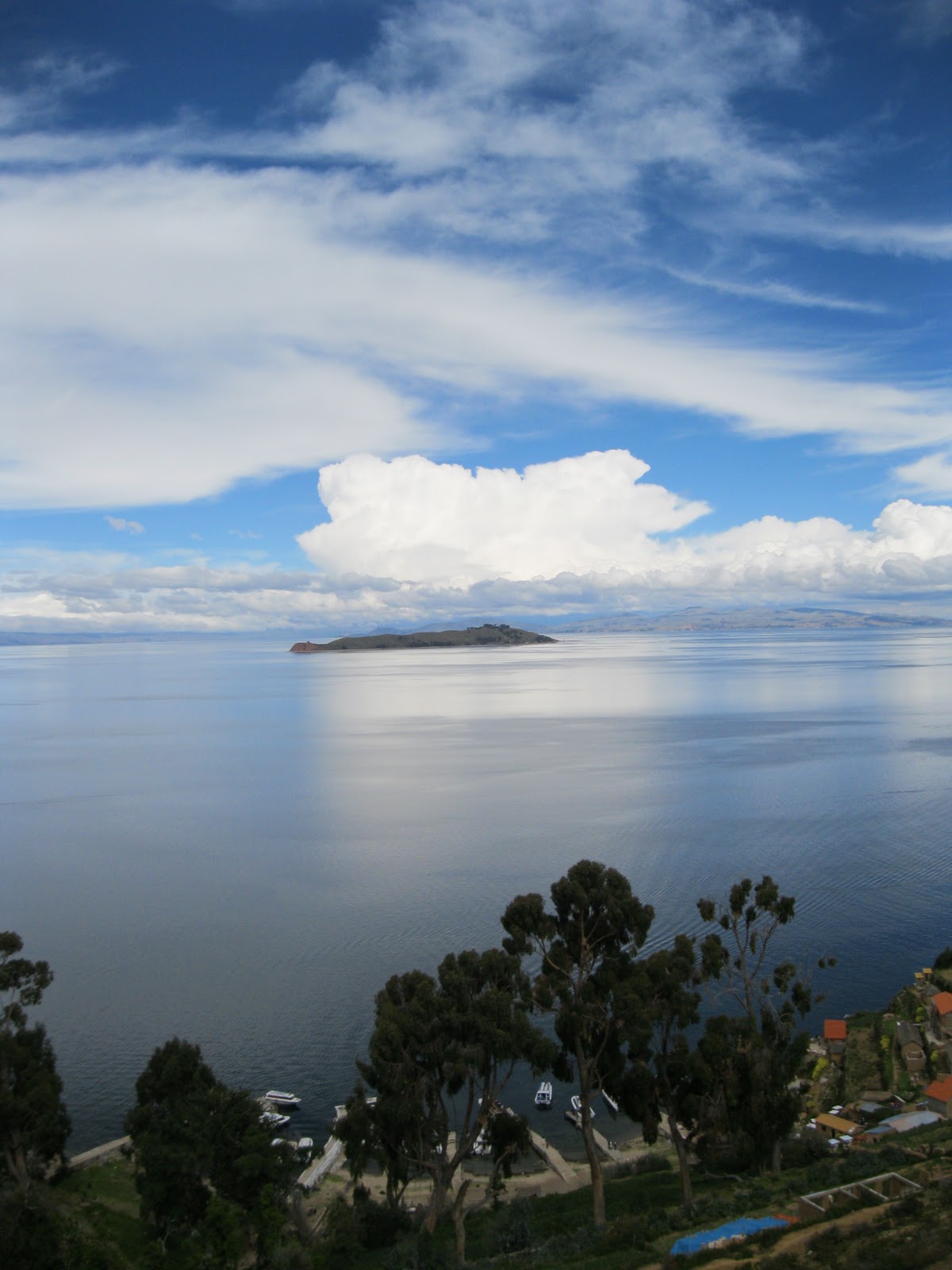
Lake Titicaca

Lake Titicaca is a huge lake on the border, a length of 190 kms or 58 000 squared kms, 60% of which is in Peru and 40% in Bolivia.  There are 35 islands on the lake, as well as 60 man-made floating islands.  The floating islands were first constructed in defense of or to hide from the invading Spaniards.  I found it really interesting that although the islands are all on the same Lake, some of them traditionally speak the Quechua language and others the Aymara language.  Although similar, culture varies from island to island and from surrounding community to community.

The floating island of Uros is supported by 5 families, as is general for each floating community.  We were greeted by the families in their traditional attire (still generally worn all the time) and with a mini-demonstration and explanation of how the islands are created and maintained, which I found fascinating.  The islands are made from reeds that float on square meter blocks of earth that the reeds grow on.  Fresh layers of reeds are placed over the island every week in order to keep it floating and maintained.  Most of the islands have a little fishing pond in the center where they can catch a variety of 5 different fish from the lake.  The white part of the reeds which they use to build their islands and homes can also be eaten, and is still quite a staple, having a consistancy somewhat like celery but tasting distinct from anything I've ever had.  Drinking water is gathered from the lake and purified with tablets.  The islands are held in place by anchors and are possible to be cut and separated, which has happened due to family disputes.  Some of the islands, such as Uros, have small solar panels for their homes, which have been donated in recent years, so that they can have light after dark, watch tv or listen to the radio.   They do have toilets, which are flushed back into the lake below.    The island people are still quite traditional, and rely to a huge degree on tourism, selling their hand-made products, tours of their islands and rides in the reed-built boats. There are schools and even seventh day Adventist, evangelical churches and mormonism on the islands.
UROS ISLAND


Typical community on a floating island

Miniature replica of an artifical island, sitting above a square meter block they use for keeping their islands afloat

Kitchen stove and pans

The women sending us off with a traditional song


Island of Amantani

Part of the tour was an overnight family stay on Amantani Island, including a good hike up the mountain to some ancient ruins and a beautiful view of the island and Titicaca Lake before sundown.  It is a beautiful island with rock fences bordering all of the pathways, homes and fields.  The family I stayed with have been hosting tourists in their home since the 80's.  The food was simple and meatless, the rooms also simply decorated but with normal mattresses and sheets and adorned with their traditional blankets.  All agriculture is still done by hand, and their are no machines or vehicles on the island.

The family home I stayed in for the night
Home-stay private room

Island of Amantani


Bolivia

The closest main stop across the border from Puno is Copacabana, a quaint little touristy-type town with a street lined with great restaraunts and little gift shops.  I had the best fried trout there!   From Copacabana traffic is routed across a channel and it's another five hours or so by bus to La Paz, a huge city, very underdeveloped and disorganized.  They still do not have bus stop signs and there were long line-ups of locals waiting for the buses up and down the streets, especially at night.   But, because the Boliviano currency is so low, (right now one Canadian dollar is 6.91 Bolivianos) it's a great place for outsiders to shop for good deals on electronics, clothes, and musical instruments. 

Transporting our bus accross the channel
Near Copacabana

Copacabana, Bolivia

La Paz, Bolivia

Before heading back over the border and getting an update on my visa, I got to see one more attraction along the way.  Also on Titicaca Lake, Island of the Sun is a quaint island also saturated in history and culture dating back to as early as 3rd millenium BC.  The terrain is very rocky, but pretty with rock pathways, terraced fields and the view of the waterfront.  The whole way from Puno to La Paz there were kids working in the tourism sector, operating the boats, or trying to sell homemade wares on the islands.  The kids on Isle del Sol were very insistant to get 'tips' of any photos taken of their island animals, and I was swarmed for a photo under a rock archway by a group of little kids.
Throughout all of this area, the people seem very industrious and work hard for their living, yet are content with the little they have.

Island of the Sun


A shot of Island of the Moon
from Isle del Sol
Add caption


The boy in this photo was quick to insist I pay after taking photos of his baby donkey

The kids who looked so casual prior, all swarmed in for this photo and then had hands out asking for 'tips'.  My 20 centimos for each one wasn't enough apparently, as they asked for 1 dollar each, or, since I didn't have any more change, bills would be okay too!

Our very casual, young boat operator from Isle del Sol back to Copacabana


Friday, 30 December 2011

Navidad


Traditions

This has certainly been the most busy month I've spent here, much like December's are back home. 
I've been trying to get more arts and crafts in with the children every week, especially Christmas-themed ones, accompanying the kids to little parties, decorating the Casa, and doing lots of baking in the evenings.


The kids have had lots of attention and special activities throughout the month.  A tradition here is to have Chocolatada's around Christmas, which are like little fiestas especially for the children and sponsored by schools, churches, businesses or other groups.  They most often consist of home-made hot chocolate, panetón and simple gifts for the kids.  We had one at the Casa put on by some of the administrators of the orphanage.  We were also invited to another hosted by a montessori school in the community.  That was a fun little adventure, as we walked the kids through a beautiful field in bloom, past a couple of grazing llamas (I think I was the only one excited by that), and up a steep hill to the school. 

There are different versions of the home-made hot chocolate in different regions, but the Cusco version includes melted blocks of real dark chocolate, cloves, cinnamon and condensed milk.
The Panetón is a boxed soft bread that is found on the shelves throughout the year but especially popular at this time of year.  Much like Christmas cake, it has the candied red and green pieces and dried fruit.


I was invited to attend a graduation dinner only a few days before the 25th, and got to find out where all the good shops are in Cusco for buying dresses or shoes, shopping with the graduate and her friend.  After 3 nights of looking for size 10 or 11 women's dress shoes I know that Cusco does not carry this size!  We did, however, find a shop that made special-sized shoes for men and women including sizes 13, 14 and 15 women's shoe-sizes!  (But, no size 10 or 11's!)
Because the kids here start school so young, most of the graduates are 15 or 16 years old and many have great college or university aspirations for the following year.


I had offered to work Christmas eve night at the Casa, but ended up with the night of the 23rd, working from 4pm to 9am the next morning.  It was all of about 3 hours of sleep waking up to babies needing attention every hour and a half.  Big salute to all mom's out there, and especially the Mama's of the House where there are currently 4 babies under 6 months old!

Christmas eve was spent with my Peruvian family where I learned that their traditional Christmas dinner is typically served after midnight.  Much like New Year's Eve they do a countdown to 12 AM, full with fireworks, everyone hugs and says a blessing over that person, and a chocolatada is served before their customary meal.  Although some people do follow our turkey tradition, others eat pork, and others (as we did) have chicken caldo soup with hearty potato, moray and yucca.  I brought a tradition from home contributing a variety of cookies including iced sugar cookies, chocolate blossoms and coconut squares.
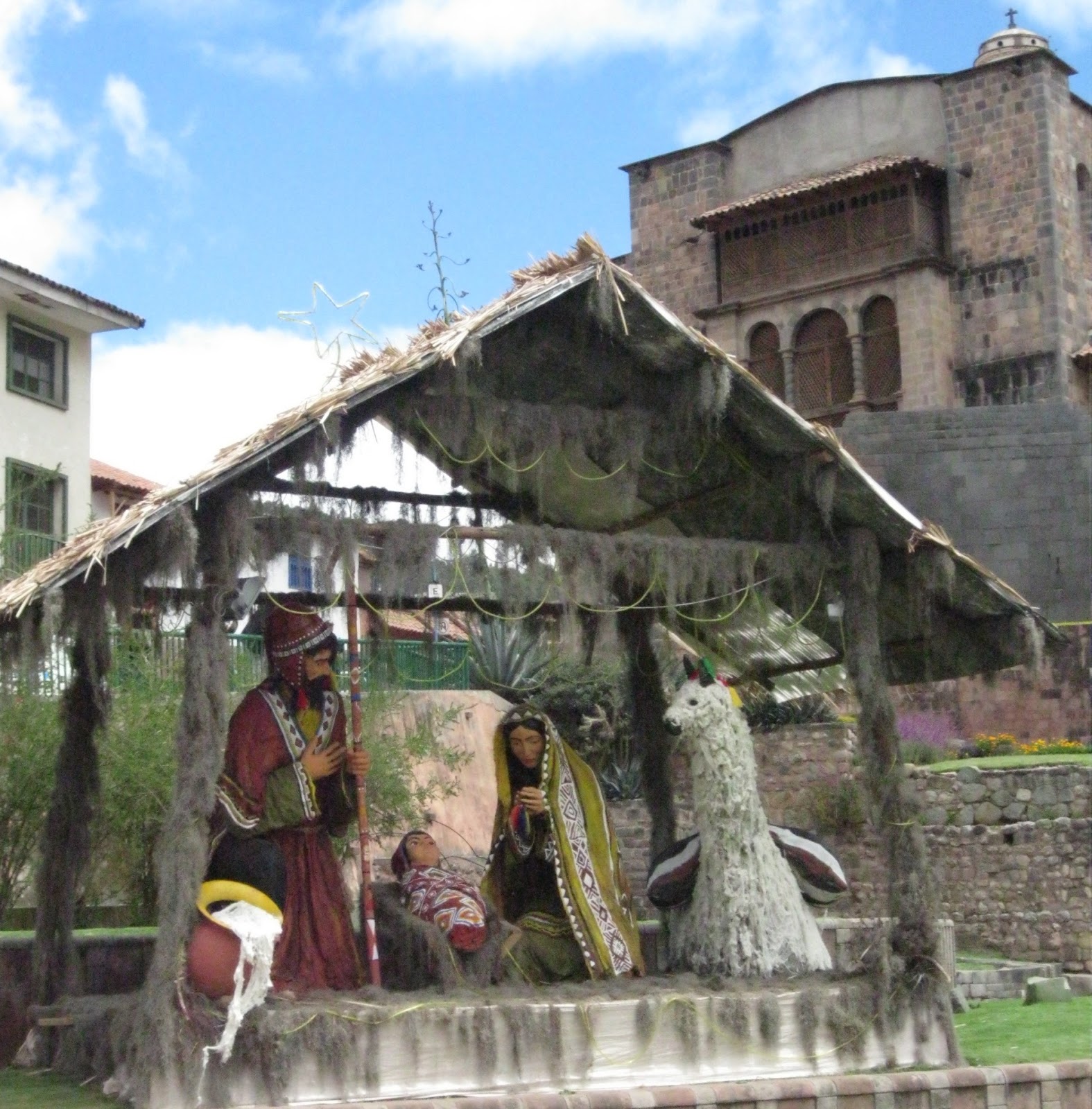
Gifts were not the focus, and most people here can't afford trees or decorations, but the town did light up the main streets and plazas with lights and lighted ornaments.  I loved the Nativity Scene in Qorikancha with the llama replacing the donkey! 


One of the more sad sites of Cusco's main streets and plazas during Christmas-time is the resemblance of homeless people: lines of village people, children included, huddled under blankets trying to stay warm for the night.  Because it's prime-buying season, many of the poorer villagers travel into town for the days before Christmas hoping to sell their crafted goods or produce items for a little extra money and in the hopes that they might participate in a sponsored chocolatada where they can get a warm drink, fill their bellies with bread and recieve a small gift for their child.  It rained through part of Christmas eve night and all Christmas day.  Without in-house heating, 6 degrees overnight is COLD!  I can't imagine how uncomfortable and difficult it was for some of those families to stay warm and dry those nights on the streets, hoping only for something that might temporarily fulfill.

I have to wonder that if the better part of the world spent less on all the materialistic goods and decorations and lights that are kept in boxes and closets the other 11 months of the year, how much could it benefit the third world in areas of true need?

Love Came Down

God gave us the freedom to choose the way we want to live our lives.  He doesn't force Himself on us, yet, He is always waiting with open arms for us to turn to Him and admit our need.  (After years of living life 'my way', I can say I know that God's way is always better).  Though He may seem like a distant God, He loves His creation and created so much.  He knew that all the rules of the Old Testament were not enough to keep stubborn man on track, and so He sent a most precious gift, out of the greatest love.
All Christmas things, traditions and even the birthdate and origins aside, it's a pretty miraculous gift that Jesus came to the earth.  God in human form... so that we could know that He understands us through and through and has experienced every pain, discomfort, temptation, and sin that we are faced with.  Yet, Jesus is the only one who has lived a sinless life on this earth.  The perfect, free gift, for a perfect and better path, that is offered for eternity!

Luk 2:10-11   And the angel said to them, Do not fear. For behold, I give to you good tidings of great joy, which shall be to all people. For to you is born today, in the city of David, a Savior, who is Christ the Lord.

1 John 4:10  This is real love—not that we loved God, but that he loved us and sent his Son as a sacrifice to take away our sins.